乾季長期化や砂質土壌での水不足に対し、当社は生分解性超吸水性ポリマー(EFポリマー)と現地実証ベースの根域保水プロセスを組み合わせて提案。限られた灌水で苗の活着・生育を安定化させる、グローバル農業ソリューション事例。 Root-Zone Water Retention for Drought and High-Temperature Stress Countermeasures | On-Site Demonstration Solutions for Biodegradable Superabsorbent Polymers (EF Polymer) | フジケミ・トレーディング株式会社

2026.06.14

Root-Zone Water Retention for Drought and High-Temperature Stress Countermeasures | On-Site Demonstration Solutions for Biodegradable Superabsorbent Polymers (EF Polymer)

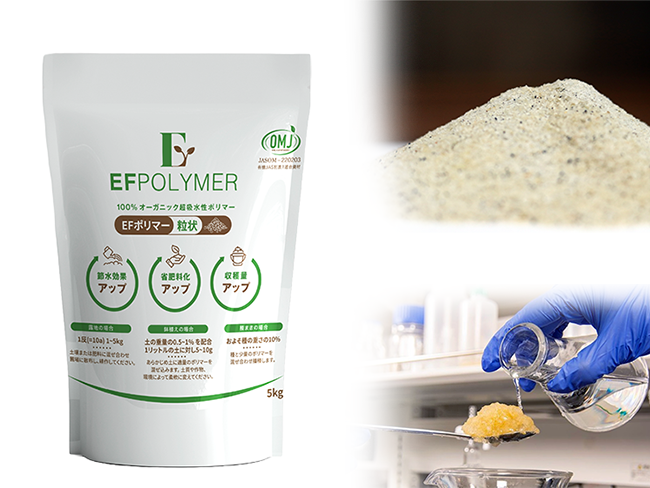
For regions where seedlings must be raised with limited irrigation, such as during prolonged dry seasons or in sandy soils, we propose a combination of the biodegradable superabsorbent polymer “EF Polymer” and a root-zone water retention process based on local verification. Starting with demonstrations in Nigeria, we are driving global expansion into the agriculture, afforestation, and greening sectors.

The Water Shortage Challenge of “Prolonged Dry Seasons × Sandy Soil” Occurring in Nigeria

As dry seasons lengthen and rainfall becomes unpredictable, limited irrigation is absorbed by sandy soil before reaching the root zone, making survival rates and growth unstable. Securing and efficiently utilizing agricultural water has become urgent. Even if the irrigation volume is increased, water escapes in sandy soil, leading only to soaring costs.
● Scenarios where this becomes apparent: Overseas farmland and afforestation sites. Backed by the prolongation of dry seasons due to climate change.
● Main impacts: Decrease in seedling survival rates, uneven growth, and deterioration of crop yields and afforestation success rates.

Why Increasing Irrigation Does Not Solve the Problem: Dual Factors of Natural Elements and Soil Physical Properties

In addition to natural factors (prolonged dry seasons and unpredictable rainfall), the water retention capability of sandy soil is low, making it impossible to retain water in the root zone.
● Grounds for identification: Observations at local fields and control test data.

Countermeasures Attempted So Far and Their Limits

Increasing irrigation volume (limited by water costs and labor) and water-retaining mulch materials (washed away by wind and rain).
Based on these limitations, we adopted the following approach as a more fundamental solution.

Solution Approach: EF Polymer × Local Control Tests × Packaging of the Application Process

Proposing a new material (biodegradable superabsorbent polymer) combined with collaboration between overseas bases and partner trading companies, and designing a root-zone water retention process based on local verification (control tests).

STEP. 01

New Material Proposal

Selecting EF Polymer (biodegradable superabsorbent polymer)

STEP. 02

Local Control Tests

Optimizing application and irrigation processes for each crop and soil condition

STEP. 03

Leveraging Partner Networks

Supplying locally through overseas bases and overseas partner trading companies

Fuji Chemi Trading’s Supply System: Headquarters × Overseas Bases / Overseas Partner Trading Companies × Partner Manufacturers

This solution is established through a clear division of roles among multiple bases:
・Headquarters / Sales: Project promotion and inquiry contact window
・Overseas Bases / Overseas Partner Trading Companies: Local sales and distribution
・Partner Manufacturers: EF Polymer supply and physical property data provision
● Supply System: Verification in local fields → Packaging and supplying the application process.

Results of Implementation

Soil water retention capability is improved, stabilizing seedling survival and crop growth even with limited irrigation.
● KPI Candidates: Improvement in survival rate / Growth volume per unit of irrigation / Crop yield / Afforestation success rate.
● Implementation Lead Time: Phased operation from local verification to establishing the application process and formal implementation.

Anticipated Ripple Effects and Horizontal Expansion

The benefits of implementing this solution extend beyond solving the primary issues. Please utilize this as material for internal and management proposals.
・Opportunities to participate in ODA and international organization (FAO, JICA, etc.) projects
・Expansion into sectors other than agriculture (greening, turf, urban heat island countermeasures)
・Since EF Polymer is biodegradable, it serves as a strong appeal for “plastic-free” and “prevention of soil contamination”
・Brand enhancement through connection with climate change adaptation and SDGs (Goals 2, 6, 13, and 15)

Differences from Competitors: Why Fuji Chemi Trading is Chosen

Trading companies exporting polymers standalone have thin on-site verification know-how. Fuji Chemi can provide a one-stop service of “material supply + local control tests + application process design.”

Product Information & Specification Overview

The main specifications of products with a proven track record can be selected from multiple grades depending on the application and required conditions. Representative specifications are as follows (please contact us for detailed specs).

ItemContent
Product NameEF Polymer (100% bio-based superabsorbent polymer / water-retaining material)
Raw Materials / FeaturesUpcycling crop residues such as fruit peels and pomace (circular economy)
ShapeGranular / Powder / Biodegradable small pouches, etc. (depending on application and grade)
Main ApplicationsAgriculture (open fields and greenhouses) / Seedlings and transplanting / Afforestation and greening (water retention and drought stress countermeasures)
Potential ApplicationsBeauty and cosmetics (liquid foundation, lipstick, etc.) / Facial sheets / Packaging (earth-returnable wrapping)
Related AreasOpportunities to participate in ODA and international organization (FAO, JICA, etc.) projects

Utilization Methods and Operation Examples

In actual operations, the following patterns are frequently adopted:
・Evaluation Phase: Requirement hearing → Sample evaluation → Specification finalization
・Pre-Mass Production Preparation: Division of roles across bases, specification standardization, and local startup
・Mass Production Phase: Ensuring short delivery times and stable supply through our supply system
・Horizontal Expansion: Supporting expansion into other bases and projects

FAQ (Frequently Asked Questions)

How do you proceed with local verification?

We conduct hearings regarding soil quality, root structure, and irrigation methods, and then perform control tests with and without EF Polymer on a ridge-by-ridge basis.

Are there any restrictions on target crops?

It can be widely applied from open field and greenhouse vegetables to afforestation and greening. We design the application position and timing for each crop.

Is expansion into fields other than agriculture possible?

Yes, there is potential for application in greening, turf, urban heat island countermeasures, beauty and cosmetics, and packaging fields.

Is collaboration with ODA and the public sector possible?

Yes, we can accept consultations regarding opportunities to participate in projects for international organizations such as FAO and JICA.

Can you provide multilingual data sheets?

We are currently preparing multilingual reference materials for overseas projects. Please let us know your requirements.

Proposals by Related Applications and Challenges

CASE 20 | 100% Eco-Friendly Water-Absorbing & Deodorizing Bag (F+BAG ACE)
CASE 22 | Compact Seawater Desalination Equipment WAQUA
CASE 01 | Reducing Factory Running Costs via Heat-Shielding Paint

For consultations regarding our products and services,please feel free to contact us here.

Inquire about this product
この用途・課題別の提案を書いた人

この用途・課題別の提案を書いた人

Fuji Chemi Trading Co., Ltd. Sales Department III

Industry: Agriculture / Afforestation / Agricultural Material Wholesalers / Agricultural Cooperatives / Government Agencies / NGOs | Bases: Overseas (via Partner Trading Companies - Global) (Headquarters / Overseas Partner Trading Companies / Partner Manufacturers) | Related Products: EF Polymer (Biodegradable Superabsorbent Polymer)

Solutions by Application and Challenge in the Same Category

CASE

Thermal Barrier Paint Solution to Reduce Factory Electricity Bills in Thailand | Arranging Local Application Partners | Collaboration Across 3 Bases: China, Thailand, and Vietnam

In the Thai manufacturing industry, continuous increases in electricity rates and prolonged dry seasons have caused factory electricity bills—primarily for air conditioning—to squeeze profits. Focusing on the application of thermal barrier paint to roofs, we provide one-stop support ranging from electricity bill reduction simulations to the arrangement of local application partners and localized currency quoting. As a realistic solution to lower running costs with low investment and short construction periods, this has already been adopted by multiple Japanese factories. Soaring Electricity Bills in Thailand: What Was Happening Inside the Factories? Electricity rates in Thailand have undergone repeated increases due to fuel cost adjustments, making the pressure on production costs a chronic issue. Especially in factories with large roof areas, coupled with the prolonged high temperatures of the dry season, air conditioning systems run at full capacity constantly, inflating annual electricity bills to a level that demands executive-level management decisions. On the other hand, upgrading power reception and transformation equipment or installing solar power presents high hurdles regarding initial investment, construction periods, and the shutdown of existing facilities, leaving many facilities unable to take action."We want to lower our electricity bills. We also want to deliver results in the context of SDGs and CO2 reduction. However, we cannot commit to capital expenditure on equipment."——We hear these exact concerns from numerous Japanese factories operating local subsidiaries. Why Aren't Electricity Bills Dropping? Radiant Heat from the Roof Keeps Air Conditioning Running Constantly The root cause revealed through on-site inspections and roof surface temperature measurements is a structural issue: the roof and exterior walls lack heat-insulating performance, allowing radiant heat to flow directly into the interior. In some cases, the roof surface temperature exceeds 70°C during the day, and this heat warms up the ceiling space and indoor air, meaning the air conditioning cannot keep up no matter how much it cools.Furthermore, factory buildings in Southeast Asia often have outdated insulation specifications, so upgrading air conditioning units alone rarely provides a fundamental solution—this is the main reason why many hesitate when considering upgrading existing facilities.The basis for identifying this cause comes from cross-referencing the following two points:・Reviewing current electricity bill data provided by the customer・Measuring roof surface temperatures and checking roofing materials during on-site inspectionsBy matching these two datasets, we can conclude with near certainty that "heat inflow from the roof is the dominant factor." Countermeasures Attempted Thus Far and Their Limitations Countermeasures already attempted by many factories share the following common limitations:・ Adjusting HVAC operating hours: The effect is limited, and the system still faces high loads during production hours.・ Considering heat-insulating film application on the roof: Frequently abandoned due to hurdles in cost and construction periods.・ Considering retrofitting insulation materials to existing equipment: Requires halting existing equipment during construction, resulting in too great an impact on production.Given these limitations, thermal barrier paint emerges as the realistic solution—a move that "reduces heat inflow from the roof without stopping existing operations." Solution Approach: Thermal Barrier Paint × Electricity Bill Simulation × Local Application Partners By focusing on top-coating existing roofs with thermal barrier paint and providing the following three components as a complete package, we lower the hurdle for customers to make the decision to "give it a try." STEP. 01 Sourcing Alternative Materials and Replacements We perform a matrix comparison of both Japanese and local manufacturer products based on required performance, roof material compatibility, and cost to select the optimal thermal barrier paint grade. Focusing primarily on products with a proven track record in Thailand, we also obtain evaluation data from cooperating manufacturers as needed. STEP. 02 Presentation of Electricity Bill Reduction Simulations Based on current electricity bill data, HVAC operating hours, roof area, and insulation specifications, we will estimate the post-application electricity bill reduction effects and the payback period. Visualizing the "numbers" necessary for management decisions significantly accelerates the internal approval speed. STEP. 03 Selection of Local Construction Partners and Quotations in Local Currency Leveraging our Thai base as a starting point, we select reliable local application partners and optimize pricing and lead times via local currency quoting. We also propose process designs that minimize the impact on your production, including night/weekend application and split-phase application block by block. FUJICHEMI TRADING's Support Framework: A Powerful Triad of Japan HQ, Thai Base, and Cooperating Manufacturers This solution is realized through a clear division of roles among three parties: Japan HQ (Sales/Technical), our Thai base, and cooperating manufacturers.・ HQ (Sales/Technical): Selects coatings / Prepares electricity bill reduction simulations / Supports decision-making for adopting companies・ Thai Base (Local Subsidiary): Conducts on-site inspections, selects application partners, and provides local currency quoting/contracting / Manages application and construction / Provides after-sales support・ Cooperating Manufacturers: Supplies thermal barrier paint / Assists in grade selection / Provides evaluation data● Supply Framework: Local inventory support and small-lot application are available. This enables a small-start introduction where you can first test the effects on a single building before rolling it out across subsequent buildings. Results of Adoption: Simultaneously Achieving Running Cost Reductions and Workplace Environment Improvements We have received the following qualitative and quantitative result reports from adopting companies:・ Reduction in factory running costs (electricity bills): Achieved a reduction (▲) in electricity bills based on actual customer data.・ Lower indoor and roof surface temperatures: Stabilized summer production efficiency due to improvements in perceived temperature.・ Visualization of the payback period: Increased the precision of management decisions, accelerating subsequent rollout evaluations.・ Rollout track record: Cases exist where introduction to a single building led to expansion across additional buildings and sister factories.● Introduction Lead Time: Rapid turnaround is possible from the initial consultation through estimation to test painting. Anticipated Ripple Effects and Rollouts: 3 Returns Beyond Just Electricity Bill Reductions The effects of adopting thermal barrier paint extend far beyond electricity bill reductions. Please utilize these cascading ripple effects triggered by "heat mitigation" as supporting material for your internal proposals.1. Workplace Environment Improvement → Lower Turnover Rates and Higher ProductivityBy mitigating the extreme heat directly beneath the roof, the workload on workers during hot seasons is reduced. As securing and retaining operators is a pressing management issue in Thai manufacturing sites, improving the workplace environment directly links to lower turnover rates and enhanced productivity.2. Contribution to SDGs and CO2 Reduction ReportsElectricity bill reductions can be directly quantified as carbon emission reductions, leading to immediate score improvements in CSR and supplier evaluations. In an era where global headquarters' procurement standards closely scrutinize "suppliers' CO2 reduction track records," leaving behind quantitative data holds great value.3. Extending the Service Life of Rooftop EquipmentLowering the roof surface temperature reduces thermal stress on outdoor HVAC units and solar panel peripheral equipment, which can be expected to extend equipment life. This creates a double benefit: electricity bill savings combined with delaying future equipment replacement costs.Furthermore, for customers who establish a proven track record of introduction in Thailand, we can also support the horizontal rollout of identical proposals to your factory bases in Vietnam and China. Differences from Competitors: Why Choose FUJICHEMI TRADING? Compared to competitors that only sell coating products (paint manufacturers' direct sales and local chemical trading companies), our unique strength lies in our ability to provide a seamless, end-to-end service encompassing "electricity bill simulations + local application partner arrangements + local currency settlement." Our network, which bridges Japanese-level quality and localized cost structures, is the reason we continue to be chosen.・Difference from Manufacturers' Direct SalesThey do not provide simulations or arrange application partners, requiring customers to handle these arrangements individually.・Difference from Local Paint DistributorsWe offer selection based on Japanese quality standards, along with technical support in Japanese and proposal materials tailored for executive-level management. Product Information & Specifications Overview The main specifications of our proven thermal barrier paints offer a choice of multiple grades depending on the application and roofing materials. Typical specifications are as follows (please contact us for detailed specifications). ItemSpecificationsApplication TypeSelectable from Water-based / Solvent-basedApplicable Roofing MaterialsMetal roofs (folded-plate, ribbed-seam, etc.) / Concrete roofs / Slate roofsStandard Film Thickness100–200 μm (Adjustable depending on application and roofing material)Reflective PerformanceHigh-reflection type can be selected for both visible light and near-infrared regionsWeather Resistance5–10 year class (Varies depending on the product)Application MethodRoller / Spraying (Selected based on on-site conditions)Service AreaAll over Thailand (Identical proposals are also available in Vietnam and China) How to Utilize & Operational Examples In actual operations, the following patterns are frequently adopted:・ Step-by-step introduction building by building: Apply to one building first for effect verification, then expand to additional buildings and sister factories after reviewing results.・ Scheduling before the hot season: To maximize the effect, it is ideal to complete the application before entering the dry season.・ Synchronization with existing facility maintenance: Co-execute with roof waterproofing renovations or HVAC upgrades to compress scaffolding costs and minimize weekend production impacts.・ Standardization across multiple bases: Led by HQ procurement, unify the thermal barrier paint specifications across multiple local factories. FAQ (Frequently Asked Questions) Are there any restrictions on the roofing materials? Our solutions support major roofing materials including metal, concrete, and slate roofs. Since the optimal grade varies depending on the material and shape, we will provide a proposal after an on-site inspection. What is the estimated payback period? It varies depending on the roof area, electricity cost rates, and HVAC operating hours. If you provide your current electricity bill data, we will run a simulation to calculate a specific payback period for you. Can the application be performed without stopping existing production? Yes. We will propose a process design that minimizes the impact on your production, including night application, weekend application, and split-phase application block by block. How can the effects be measured? Measurement is possible by comparing roof surface temperatures, indoor temperatures, and electricity bills. We also support you starting from the selection of representative measurement points. Is support available at overseas bases outside of Thailand? Yes, we can roll out identical solutions at our bases in Vietnam and China (Shanghai). For customers with multiple locations, we can also propose the standardization of specifications across all bases. Proposals by Related Application and Challenge ■ Factory Electricity Bill Reduction & Heat Mitigation | Developing Thermal Barrier & UV Cut Sheets with Custom Processing (Japan-ASEAN Collaboration)■ Reducing Production Line Stoppage Risks via Local Stock in Thailand for Automotive Parts | Supplying Molding Resins and Rubber through BCP Schemes

コストダウン

コストダウン × 海外拠点活用

タイ拠点

原価低減

塗料用樹脂

接着剤

施工パートナー

環境・省エネ対応

遮熱塗料

Reducing Factory Electricity Costs & Heat Countermeasures | Developing Custom-Processed Heat-Insulating & UV-Cut Sheets (Japan-ASEAN Collaboration)

In response to the triple demands of soaring electricity costs, SDGs compliance, and working environment improvement, our company has designed an original processed sheet with heat-insulating and UV-cutting functions. By coating non-woven fabrics or films with specialized paint and providing them in a format that lowers installation barriers, we have expanded our target audience to include customers with rental properties and those looking to protect existing facilities. Triple Demands: Soaring Factory Electricity Costs, SDGs Requirements, and Working Environment Improvement There is a strong desire to simultaneously reduce factory electricity costs and implement heat countermeasures. Many customers requested a sheet format that is easy to install, rather than just the paint itself.A format was needed that could be implemented even by customers for whom applying paint is difficult (rental properties, protection of existing facilities).● Scenarios of Emergence: The triple demands of rising electricity costs, SDGs compliance, and working environment improvement are becoming prominent.● Main Impacts: Deterioration of factory running costs, decline in winter/summer working efficiency, and unfulfilled CSR requirements. Why Existing Solutions Fall Short: Paint Application Barriers and the Limits of Conventional Insulation Materials Conventional heat-insulating countermeasures were based on the premise of paint application, creating a high barrier for installation work.● Specific Basis: Sample evaluations and on-site interviews. Solutions Tried So Far and Their Limitations Installing conventional insulation materials (unfeasible due to weight and poor workability), updating air conditioning units only (requires large investment).Based on these limitations, we adopted the following approach as a more fundamental solution. Solution Approach: Optimizing the Combination of Paint, Film, and Non-Woven Fabric × Developing Custom-Processed Products We developed our own custom-processed product by coating non-woven fabrics and films with specialized paint, lowering implementation barriers through sample provision and small-lot sales. STEP. 01 Material Combination Optimization Reviewing the configuration of paint × film × non-woven fabric STEP. 02 Custom-Processed Product Development Transforming into an easy-to-install format through coating and slitting processes STEP. 03 Utilization of Overseas Bases Utilization and cross-regional expansion of products supplied overseas (sharing evaluation data) STEP. 04 Cost Simulation Visualizing cost structures to support informed implementation decisions Fuji Chemi Trading's Service Network: Head Office (Sales & Technology) × ASEAN Bases This solution is achieved through a clear division of roles across multiple bases.・Head Office / Domestic Sales: Customer window and cost simulation・Technology & Development: Coating recipe development for paints, and preparation of evaluation data・Thailand and Vietnam Bases: Sharing evaluation track records at ASEAN factories● Supply System: Sample provision, small-lot sales, and in-house custom processing support. Results of Implementation Achieved a reduction in factory running costs (electricity bills). Successfully developed into a cross-regional proprietary product that is also effective for acquiring new customers.● KPI Candidates: Electricity cost reduction (on an estimated basis) / Room temperature drop in implemented factories / Record of cross-regional expansion to additional buildings and group factories.● Implementation Lead Time: Fast-track response from sample evaluation to small-lot supply. Anticipated Ripple Effects and Cross-Regional Expansion The implementation effects of this solution go beyond solving the primary challenge. Please also utilize it as compelling material for internal and management-level proposals.・Continuous tailwinds from soaring electricity costs and environmental regulations will drive mid-to-long-term growth in lead generation.・Expansion to applications beyond roofs and outer walls (such as windows, skylights, and partitions).・Proposals addressing the same theme for ASEAN factories can be rolled out, driven from Japan-based sites.・Utilized internally by customers as evidence for SDGs/CO2 reduction reports, creating an internal word-of-mouth diffusion effect. Distinction from Competitors: Why Fuji Chemi Trading is Chosen While competitors sell individual paint or building materials as standalone products, Fuji Chemi differentiates itself through an original packaged solution of "Paint + Custom Processing + Overseas Data + Small-Lot Sales." Product Information & Specifications Overview The main specifications of our track-proven products can be selected from multiple grades depending on your application and requirement conditions. Typical specifications are as follows (please contact us for detailed specifications). ItemSpecificationsMain ApplicationReducing factory electricity costs, heat countermeasures, and SDGs complianceProduct FormHeat-shielding & UV-cut sheets (coated non-woven fabric/film products)Paint BaseHeat-shielding paint / UV-cut paintProcessing SupportCoating and slit-processing into forms that are easy to installSales FormSample provision / Small-lot sales supportEvaluation DataTrack records of evaluations at overseas bases (Thailand / Vietnam) can also be shared Suggested Applications & Operation Examples In actual operations, the following patterns are frequently adopted:・Evaluation Phase: Requirement inquiries → Sample evaluation → Specifications finalization・Pre-Mass Production Preparation: Division of roles across bases, specification standardization, and local on-site startup・Mass Production Phase: Ensuring short lead times and stable supply through our robust supply system・Cross-Regional Expansion: Supporting expansion to other bases and other projects FAQ (Frequently Asked Questions) What are the advantages compared to conventional paint application? Since it is a sheet-application method, it lowers the installation barriers, making it feasible for implementation even in leased properties or for protecting existing equipment. Is it possible to implement a trial on a small-lot basis? Yes, we support both sample provision and small-lot sales. Is it possible to expand the application to areas other than roofs and outer walls? Yes, expansion to various applications such as windows, skylights, and partitions is also possible. Is it possible to expand the deployment to factories in the ASEAN region? While sharing evaluation data from our overseas bases, we support your ASEAN expansion driven from Japan-based sites. Can you provide data to be used as evidence for SDGs and CO2 reduction reports? Yes, we can provide CO2 reduction estimates based on electricity cost reduction data. Proposals by Related Applications and Challenges ■ Heat-Shielding Paint Solution to Reduce Electricity Costs for Thai Factories | Arrangement of Local Installation Partners | Collaboration Across 3 Bases: China, Thailand, and Vietnam■ Stable Supply and Quality Improvement of Fluoropolymer Films (FEP/PFA) | Providing Multiple Samples with Short Lead Times through In-house Slitting Processes■ 100% Eco-Friendly Water-Absorbing & Deodorizing Bag (F+BAG ACE) | Entering the Daily Sundries and Disaster Prevention Markets with Biodegradable Non-Woven Fabric × Naturally Derived Superabsorbent Polymers

不織布・フィルム加工

原価低減

小ロット・スリット加工

環境・省エネ対応

遮熱&UVカットシート

遮熱塗料

高機能材料 x 新規開発

遮熱&UVカットシート「F+COOL」で電気代削減と猛暑対策を同時に|JIS認証取得・自社開発のオリジナル製品

猛暑による電気代高騰と暑熱負荷は、工場・店舗・住宅・屋外施設のいずれにとっても看過できない経営課題です。当社のオリジナル製品「F+COOL(エフ・クール)」は、太陽光エネルギーの約50%を占める近赤外線(IR)を効率反射し、紫外線(UV)も99.9%以上カットする遮熱・UVカットシートです。不織布タイプ・シート強化タイプの2グレードと水戸加工センターでの加工対応により、窓ガラス・屋上・エアコン室外機・テント・日傘・ベビーカーカバーなど、用途に応じたソリューションを少量から提供します。 猛暑・電気代高騰の同時進行:工場から住宅まで広がる「遮熱ニーズ」 地球温暖化の影響で日本国内・ASEAN各国とも夏季の最高気温更新が続き、空調負荷が利益を圧迫しています。同時に電力料金の値上げ・燃料費調整単価の上昇により、エアコン稼働時間が長い工場・店舗・住宅の電気代削減はSDGs対応とセットで経営テーマ化しています。 近赤外線(IR)/紫外線(UV)を一枚で同時カット F+COOL(エフ・クール) 一方、窓ガラス・屋上・室外機・屋外ベンチなど「日射を直接受ける部位」は、輻射熱で表面温度が60℃を超えるケースも多く、室内側の温度上昇・空調効率低下・機器寿命短縮を招きます。猛暑期だけでも対策したい、しかも工事を伴わない手軽な打ち手がほしい――そうしたお困りごとがBtoB/BtoC双方から増えています。●顕在化する場面:工場・倉庫・店舗の屋根/窓/室外機、住宅の窓・屋根、屋外施設(公園ベンチ・人工芝・駐車場・タープ)、自動車(ダッシュボード・ボンネット)、雑貨(日傘・ベビーカーカバー・ヘルメットカバー)など、日射を受けるあらゆる部位。●主な影響:電気代・燃料費の高騰、空調機器の過負荷・寿命短縮、屋内・車内の高温化、CO2排出量増加によるSDGs評価低下。 なぜ遮熱できないのか:単体材料では「遮熱」と「UVカット」「明るさ確保」を両立できない 従来の暑熱対策資材は、(1)遮光カーテン・暗色フィルム=室内が暗くなり昼間も照明が必要(2)一般的なUVカットフィルム=紫外線は止まるが近赤外線は通す(3)断熱材後付け=施工コスト・工期が大きいという3つの壁を抱えていました。「明るさを保ったまま」「近赤外線(熱線)を反射し」「UVを遮蔽し」「猛暑期だけ簡単に取り外せる」――この4条件を1枚で満たす材料が市場には少なく、結果として現場では複数部材の併用や暑さの我慢が起きていました。●特定の根拠:JIS L 1951(遮熱性)/JIS L 1925(紫外線遮蔽率)に基づく自社評価データ・現場検証データ・自動車ダッシュボード▲10℃・人工芝▲15℃・・日傘表面▲22℃・アスファルト・コンクリート▲13℃など これまで試した対策とその限界 遮光カーテン・暗色フィルムの設置(室内が暗くなり業務効率が低下)、汎用UVカットフィルム(紫外線は止まるが熱線は素通り)、断熱材後付け(工期・コストの壁で見送り)、エアコン能力増強(電気代がさらに上昇)など、複数の打ち手が試されてきましたが、いずれも遮熱・UVカット・明るさ確保・低コスト・取り外し容易性の同時成立に至りませんでした。これらの限界を踏まえ、より抜本的な打ち手として下記アプローチを採用しました。 解決アプローチ:IR反射層 × UV遮蔽 × 3グレード展開で用途別に最適化 不織布タイプ シート強化タイプ 当社が自社開発した遮熱・UVカットシート「F+COOL」は、太陽光エネルギーの約50%を占める近赤外線(IR)領域を高効率で反射する設計と、UV遮蔽率99.9%以上の機能を1枚に統合。さらに不織布/シート強化の2グレード展開と水戸加工センターでの加工対応により、窓・屋上・室外機・テント・日傘・カバーなど用途に応じて最適仕様を選択できます。 STEP. 01 用途ヒアリングとグレード選定 屋内向け(窓・床・天井)か屋外向け(屋上・室外機・テント・タープ)か、必要な明るさ・耐候性・防炎仕様の有無をヒアリングし、不織布タイプ/シート強化タイプ(防炎仕様)から最適グレードを提案します。 STEP. 02 サンプル提供と現場検証 A4サイズ1枚130円〜の手軽な小ロットから提供し、お客様現場での表面温度・室温の実測検証を支援。当社実機検証(ダッシュボード▲10℃/人工芝▲15℃/窓貼付▲3〜4℃/日傘▲22℃/アスファルト▲13℃ など)を提示し、効果を数値で見える化します。 STEP. 03 加工・施工方法のご提案と量産供給 水戸加工センターでの指定サイズにスリット、小巻化に対応。窓設置・室外機カバー・タープ・日傘等の作製事例をご提供。量産化が必要な場合は、ロール出荷(巾1,000mm/指定条長)で安定供給します。 フジケミ・トレーディングの提供体制:本社開発 × 水戸加工センター × タイ拠点の3拠点連携 本ソリューションは、複数拠点の役割分担で成立しています。・本社・営業/技術:F+COOL開発元としてのデータ提供、用途別グレード提案、商標登録の保全。・水戸加工センター:指定サイズへのスリット、小巻化の二次加工対応、小ロット即出荷。・当社海外拠点:ASEAN市場での現地検証(鉄板・人工芝での実測データ取得)、現地法人経由の輸出販売・サンプル送付。 遮熱シート(ロールカーテン) タイ現地での検証(鉄板) ●供給体制:A4サイズ1枚130円〜の小ロットから1,000mm巾ロール出荷まで対応。猛暑期前の繁忙期にはまとめ取りも可能です。 導入による成果 工場・事務所での導入では、窓周り表面温度が3〜10℃低下し、エアコン設定温度を1℃上げるだけで電気代が10〜13%変動する経済性から、室温▲3℃で電気代▲約30%の効果が試算されています。屋外機器・ベンチ・人工芝・日傘でも表面温度差10〜22℃の遮熱効果を実測。リフォーム会社のYouTubeチャンネル等でも紹介され、認知度が向上しています。●KPI候補:表面温度低減(▲10〜15℃)/UV遮蔽率99.9%以上。●導入リードタイム:サンプル評価から本格採用まで短期間。A4サイズ即出荷可、量産巾1,000mmは指定条長で対応。 自社検証データ(抜粋) 自動車ダッシュボード 検証環境(気温29℃) ダッシュボード▲10℃/F+COOL部 45℃ 公園ベンチ 検証環境 ベンチ▲10℃/F+COOL部 35℃ 人工芝 検証環境(気温37℃) 人工芝▲10℃/F+COOL部 56℃ 想定される波及効果と横展開 本ソリューションの導入効果は、主課題の解決にとどまりません。社内提案・経営層提案の材料としてもご活用ください。・工場ランニングコスト削減 → CO2削減レポート・CSR資料への数値貢献・労働環境改善(屋根・窓近傍の暑熱緩和)→ 離職率低下・生産性向上・店舗・住宅・公共施設(公園ベンチ・観戦施設・駐車場)への横展開・自動車・ベビーカー・ヘルメット・日傘など雑貨BtoCマーケットへの拡張・ASEAN各国(タイ等)での現地販売・OEM展開 ベビーカー フードカバー ヘルメットカバー 工場引き戸(外側) 工場引き戸(内側) 同業他社との違い:なぜフジケミ・トレーディングが選ばれるのか 市販の汎用遮熱フィルム・カーテンに対し、F+COOLは「IR反射+UV遮蔽率99.9%以上+明るさ確保」を1枚で実現し、JIS認証に則った自社測定で性能を裏付けています。さらに当社は商社機能を活かし、原反販売・水戸加工センターでの二次加工・海外拠点での展開・少量小口販売(A4 1枚〜)まで一気通貫で対応。リフォーム会社や個人ユーザーにも届く価格帯・流通体制を持つ点が独自の強みです。 製品情報・スペック概要 採用実績のある製品の主なスペックは、用途と要求条件によって複数のグレードからお選びいただけます。代表的な仕様は以下の通りです(詳細スペックはお問い合わせください)。 仕様不織布タイプシート強化タイプ(防炎仕様)製品巾1,000mm1,000mm製品長指定条長指定条長厚み(代表値)230μm130 / 200μm遮熱性 ※JIS L 195150(S45)%不織布タイプ相当紫外線遮蔽率 ※JIS L 1925≧99.9%不織布タイプ相当参考価格(不織布標準)A4:130円〜/500×1,000mm:750円〜(送料別) 活用方法・運用例 実際の運用は、以下のようなパターンが多く採用されています。・窓ガラスへの設置:F+COOLを裁断し上下を折り返し縫製、突っ張り棒で取り付け。冬場は取り外し可能。・エアコン室外機カバー:天板サイズに合わせ裁断し両面テープで貼付、室外機表面温度▲約15℃。・タープ・すだれ:ハトメ加工+紐固定でDIY可能、屋外イベント・店舗ファサードに。・日傘:10本〜のオーダーメイド対応(サイズ2種類)、表面温度▲22℃・影部▲13℃の実測。・屋外ベンチ・人工芝・アスファルト:敷設で表面温度▲10〜15℃、駐車スペース・レジャー・公園施設に。・ベビーカー・ヘルメット・自動車ダッシュボードカバー:日射を受ける部位の温度低下と熱ダメージ軽減。 窓ガラスへの適用 エアコン室外機カバー タープ(すだれ) 日傘への適用 メディア掲載(YouTube):仙台のリフォーム会社「失敗しないリフォームへの案内人」 FAQ(よくある質問) JIS認証試験について 遮熱性はJIS L 1951、紫外線遮蔽率はJIS L 1925に基づき、社内測定をしております。 暗くなりませんか 障子紙のような明るさを保ちながら近赤外線を反射する設計です。屋内照明をつけずに昼間の業務を継続できます。 冬場の取り外しはできますか 突っ張り棒・両面テープ・ハトメ+紐固定など、用途に応じた取り付け方法をご紹介しています。猛暑期だけの使用が可能です。 防炎仕様はありますか シート強化タイプは防炎仕様品を選定可能です。建物・店舗での使用に対応します。 小ロット・少量での購入は可能ですか A4サイズ(210×297mm)1枚130円〜、500×1,000mm 1枚750円〜(送料別)から少量販売しています。サンプル評価から始めていただけます。 関連する用途・課題別の提案 ■タイの工場電気代を削減する遮熱塗料ソリューション|現地施工パートナー手配|中国・タイ・ベトナム3拠点連携■ホットメルトシートで接着工程の有機溶剤・乾燥工程を削減|少量・小口・短納期で環境配慮型接着を実現■新素材HUMOFIT®で体温フィット製品のサイズフリー化を実現|温度依存性シートの少量・小口・加工販売

コストダウン

加工サービス

猛暑対策 x SDGs

環境・省エネ対応

自社開発オリジナル製品

Electrical &
Electronic Materials

Inquiry form

If you have any comments, questions, or inquiries regarding our products and services, please use the form below.

This site is registered on wpml.org as a development site. Switch to a production site key to remove this banner.