Inquiry form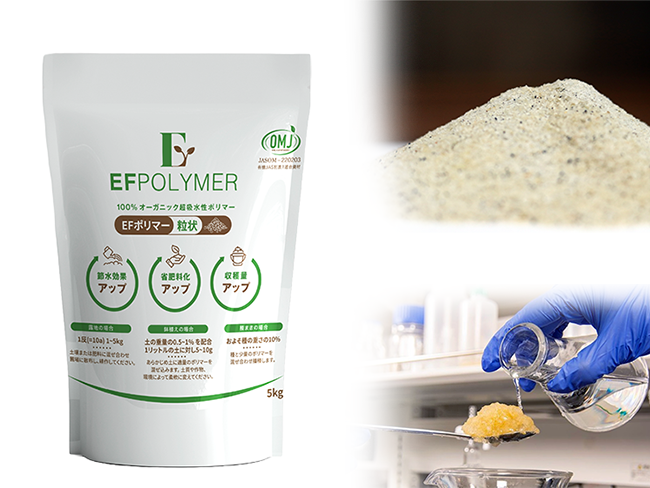
For regions where seedlings must be raised with limited irrigation, such as during prolonged dry seasons or in sandy soils, we propose a combination of the biodegradable superabsorbent polymer “EF Polymer” and a root-zone water retention process based on local verification. Starting with demonstrations in Nigeria, we are driving global expansion into the agriculture, afforestation, and greening sectors.
The Water Shortage Challenge of “Prolonged Dry Seasons × Sandy Soil” Occurring in Nigeria
As dry seasons lengthen and rainfall becomes unpredictable, limited irrigation is absorbed by sandy soil before reaching the root zone, making survival rates and growth unstable. Securing and efficiently utilizing agricultural water has become urgent. Even if the irrigation volume is increased, water escapes in sandy soil, leading only to soaring costs.
● Scenarios where this becomes apparent: Overseas farmland and afforestation sites. Backed by the prolongation of dry seasons due to climate change.
● Main impacts: Decrease in seedling survival rates, uneven growth, and deterioration of crop yields and afforestation success rates.
Why Increasing Irrigation Does Not Solve the Problem: Dual Factors of Natural Elements and Soil Physical Properties
In addition to natural factors (prolonged dry seasons and unpredictable rainfall), the water retention capability of sandy soil is low, making it impossible to retain water in the root zone.
● Grounds for identification: Observations at local fields and control test data.
Countermeasures Attempted So Far and Their Limits
Increasing irrigation volume (limited by water costs and labor) and water-retaining mulch materials (washed away by wind and rain).
Based on these limitations, we adopted the following approach as a more fundamental solution.
Solution Approach: EF Polymer × Local Control Tests × Packaging of the Application Process
Proposing a new material (biodegradable superabsorbent polymer) combined with collaboration between overseas bases and partner trading companies, and designing a root-zone water retention process based on local verification (control tests).
STEP. 01
New Material Proposal
Selecting EF Polymer (biodegradable superabsorbent polymer)
STEP. 02
Local Control Tests
Optimizing application and irrigation processes for each crop and soil condition
STEP. 03
Leveraging Partner Networks
Supplying locally through overseas bases and overseas partner trading companies
Fuji Chemi Trading’s Supply System: Headquarters × Overseas Bases / Overseas Partner Trading Companies × Partner Manufacturers
This solution is established through a clear division of roles among multiple bases:
・Headquarters / Sales: Project promotion and inquiry contact window
・Overseas Bases / Overseas Partner Trading Companies: Local sales and distribution
・Partner Manufacturers: EF Polymer supply and physical property data provision
● Supply System: Verification in local fields → Packaging and supplying the application process.
Results of Implementation
Soil water retention capability is improved, stabilizing seedling survival and crop growth even with limited irrigation.
● KPI Candidates: Improvement in survival rate / Growth volume per unit of irrigation / Crop yield / Afforestation success rate.
● Implementation Lead Time: Phased operation from local verification to establishing the application process and formal implementation.
Anticipated Ripple Effects and Horizontal Expansion
The benefits of implementing this solution extend beyond solving the primary issues. Please utilize this as material for internal and management proposals.
・Opportunities to participate in ODA and international organization (FAO, JICA, etc.) projects
・Expansion into sectors other than agriculture (greening, turf, urban heat island countermeasures)
・Since EF Polymer is biodegradable, it serves as a strong appeal for “plastic-free” and “prevention of soil contamination”
・Brand enhancement through connection with climate change adaptation and SDGs (Goals 2, 6, 13, and 15)
Differences from Competitors: Why Fuji Chemi Trading is Chosen
Trading companies exporting polymers standalone have thin on-site verification know-how. Fuji Chemi can provide a one-stop service of “material supply + local control tests + application process design.”
Product Information & Specification Overview
The main specifications of products with a proven track record can be selected from multiple grades depending on the application and required conditions. Representative specifications are as follows (please contact us for detailed specs).
| Item | Content |
|---|---|
| Product Name | EF Polymer (100% bio-based superabsorbent polymer / water-retaining material) |
| Raw Materials / Features | Upcycling crop residues such as fruit peels and pomace (circular economy) |
| Shape | Granular / Powder / Biodegradable small pouches, etc. (depending on application and grade) |
| Main Applications | Agriculture (open fields and greenhouses) / Seedlings and transplanting / Afforestation and greening (water retention and drought stress countermeasures) |
| Potential Applications | Beauty and cosmetics (liquid foundation, lipstick, etc.) / Facial sheets / Packaging (earth-returnable wrapping) |
| Related Areas | Opportunities to participate in ODA and international organization (FAO, JICA, etc.) projects |
Utilization Methods and Operation Examples
In actual operations, the following patterns are frequently adopted:
・Evaluation Phase: Requirement hearing → Sample evaluation → Specification finalization
・Pre-Mass Production Preparation: Division of roles across bases, specification standardization, and local startup
・Mass Production Phase: Ensuring short delivery times and stable supply through our supply system
・Horizontal Expansion: Supporting expansion into other bases and projects
FAQ (Frequently Asked Questions)
How do you proceed with local verification?
We conduct hearings regarding soil quality, root structure, and irrigation methods, and then perform control tests with and without EF Polymer on a ridge-by-ridge basis.
Are there any restrictions on target crops?
It can be widely applied from open field and greenhouse vegetables to afforestation and greening. We design the application position and timing for each crop.
Is expansion into fields other than agriculture possible?
Yes, there is potential for application in greening, turf, urban heat island countermeasures, beauty and cosmetics, and packaging fields.
Is collaboration with ODA and the public sector possible?
Yes, we can accept consultations regarding opportunities to participate in projects for international organizations such as FAO and JICA.
Can you provide multilingual data sheets?
We are currently preparing multilingual reference materials for overseas projects. Please let us know your requirements.
Proposals by Related Applications and Challenges
CASE 20 | 100% Eco-Friendly Water-Absorbing & Deodorizing Bag (F+BAG ACE)
CASE 22 | Compact Seawater Desalination Equipment WAQUA
CASE 01 | Reducing Factory Running Costs via Heat-Shielding Paint