電線・エアコン・各種機器メーカー向けに、ケーブルノイズ除去用フェライトコアをマルチソース化。当社が中国・タイ・ベトナム拠点を活用し、同等品質・安定供給・コストダウンを同時達成した事例。 Multi-sourcing for BCP of Cable Noise Suppression Ferrite Cores | Balancing Equivalent Quality, Stable Supply, and Cost Reduction | フジケミ・トレーディング株式会社

2026.06.03

Multi-sourcing for BCP of Cable Noise Suppression Ferrite Cores | Balancing Equivalent Quality, Stable Supply, and Cost Reduction

Quality variation and supply anxiety due to dependency on a single supplier—by multi-sourcing ferrite cores for cable noise suppression, we achieved a stable supply and cost reduction simultaneously while ensuring equivalent quality. This is a standard scheme in fields where demand is growing due to the EV shift and 5G adoption.
This solution is tailored for companies facing challenges in the stable procurement of EMC and noise countermeasure components, such as electric wire manufacturers, air conditioner manufacturers, and automotive equipment manufacturers.

Simultaneous Challenges of “Defects/Complaints & BCP” Surface in Cable Noise Countermeasures

For cable noise suppression ferrite cores, responding to defects/complaints and addressing BCP (multi-sourcing) were requested simultaneously.
Dependency on a single supplier reached its limit in terms of both quality variation and risk.
● Situations where it surfaces: The defect and complaint response phase.
● Main impacts: Frequent complaints, production line stoppages, and the requirement to balance both quality stability and cost competitiveness.

Why Dependency on a Single Supplier is Risky: Quality Variation and Prolonged Lead Times

Procurement and supply chain factors (supply anxiety, lead times). Dependency on a single supplier.
● Specific evidence/basis: Physical property comparison of existing materials, defect sample verification.

Countermeasures Attempted So Far and Their Limitations

Requesting quality improvements from the single supplier (reached its limit), and abruptly searching for alternative sources (unstable).
Based on these limitations, we adopted the following approach as a more radical and fundamental solution.

Solution Approach: Developing New Overseas Manufacturers × Parallel Supply Across 3 Sites × Iterative Prototype Evaluation

By developing new products from overseas manufacturers and coordinating across 3 sites, we achieved both equivalent quality and stable supply, while also reducing costs.

STEP. 01

Developing Overseas Suppliers

Sourced ferrite cores with equivalent physical properties

STEP. 02

Multi-Site Coordination

Parallel supply across China, Thailand, and Vietnam

STEP. 03

Iterative Prototyping and Evaluation

Confirmation of equivalent quality

Fuji Chemi Trading’s Supply Network: Headquarters × Shanghai × Thailand × Vietnam

This solution is made possible through the division of roles among multiple sites.
・Headquarters / Domestic Sales: Customer window and quality control
・Shanghai / Thailand / Vietnam: Supplier coordination, local customs clearance, and inventory
● Supply Network: Multi-source supply / Inter-site flexibility / Local delivery.

Results of Implementation

Eliminated delivery troubles, stabilized quality, and achieved cost reductions.
● KPI Candidates: Reduction in number of complaints / Zero delivery delays / Cost reduction.
● Implementation Lead Time: Repeating prototypes and evaluations, then transitioning to mass production.

Expected Ripple Effects and Horizontal Rollout

The effects of implementing this solution extend beyond solving the primary challenge. Please also leverage this as material for internal proposals and presentations to executive management.
・Rollout to general EMC countermeasure components (common mode chokes, shielding tapes, gaskets)
・Cross-industry expansion from white goods to automotive EMC countermeasures
・Perfect fit for the sharp increase in noise countermeasure demand driven by the EV shift
・Creation of BCP content under the theme of “breaking away from single-supplier dependency”

Difference from Competitors: Why Fuji Chemi Trading is Chosen

Domestic independent trading companies tend to lag behind in implementing overseas multi-sourcing. Fuji Chemi can handle parallel procurement across 3 sites in China, Thailand, and Vietnam, lowering costs while ensuring equivalent quality.

Product Information & Specification Overview

The main specifications of our proven products can be selected from multiple grades depending on the application and requirements. Typical specifications are as follows (please contact us for detailed specifications).

ItemSpecification
Main ApplicationFerrite core for cable noise suppression / EMC countermeasure components
Target IndustriesElectric wire / Air conditioners / Various equipment (White goods, automotive, etc.)
Supply TypeMulti-source supply (Multiple manufacturers, multiple sites)
SitesParallel supply across China (Shanghai) / Thailand / Vietnam sites
Related FieldsCommon mode chokes / Shielding tapes / Gaskets, etc.
Rollout ScenariosEV shift / 5G adoption / Automotive EMC countermeasures

Utilization Methods & Operational Examples

In actual operations, the following patterns are frequently adopted.
・Evaluation Phase: Requirement hearing → Sample evaluation → Specification confirmation
・Pre-Mass Production Preparation: Division of roles across sites, specification standardization, and local launch
・Mass Production Phase: Ensuring short lead times and stable supply through our supply network
・Horizontal Rollout: Supporting horizontal rollout to other sites and other projects

FAQ (Frequently Asked Questions)

How do you ensure quality in multi-sourcing?

We ensure equivalent quality by repeating physical property comparisons and prototype evaluations for each manufacturer’s product before proceeding with parallel supply.

Is it possible to propose general EMC countermeasure components?

Yes, we can propose general EMC countermeasure components, including common mode chokes, shielding tapes, and gaskets.

Is it possible to expand into the EV and automotive sectors?

Yes, we can support the growing demand for noise countermeasures driven by the EV shift. We also have a proven track record in automotive EMC countermeasures.

Is it possible to use your services in combination with existing domestic suppliers?

Yes, it is possible. By using a dual-sourcing scheme that combines domestic and overseas products, you can also leverage it as a bargaining chip for price negotiations.

What is the extent of the cost reduction?

Although it depends on the specific project, there are many cases where cost reductions can be expected by strengthening your bargaining power through multi-sourcing.

Proposals by Related Application and Challenge

■ Overseas Procurement of PET Film for Power Cables + Domestic Slitting | Cost Reduction with Equivalent Quality Guaranteed
■ BCP-Compliant Procurement of FRP Gratings for Industrial Plants | Achieving Mass Production via Overseas Supplier Development and Quality Replication
■ Adoption of Chinese-made PI Tape for Heat-Resistant Process Films | Cost Optimization through Just-Spec Specifications

For consultations regarding our products and services,please feel free to contact us here.

Inquire about this product
この用途・課題別の提案を書いた人

この用途・課題別の提案を書いた人

Fuji Chemi Trading Co., Ltd. Osaka Branch

Industries: Electric Wire, Air Conditioners, & Various Equipment Manufacturers | Sites: Japan + China, Thailand, Vietnam (HQ / Shanghai / Thailand / Vietnam) | Related Products: Ferrite Cores, Noise Countermeasure Components

Solutions by Application and Challenge in the Same Category

CASE

Achieving Space-Saving in Electronic Equipment with Anisotropic Conductive Film (ACF) × Local Slitting Process in Thailand | Integrating Connection, Insulation, and Adhesion into a Single Sheet

In OA equipment and EMS fields, demands for thinner products and cost reduction are intensifying simultaneously, while the conventional mounting method, where connection, insulation, and adhesion are handled by separate components, has reached its limits. By combining material integration into high-performance Anisotropic Conductive Film (ACF) with local slitting and small-lot supply at our Thailand base, we provide solutions that simultaneously achieve space-saving inside devices, yield improvement, and cost reduction. It has already been adopted by multiple OA equipment manufacturers and EMS providers. Simultaneous Demands for "Space-Saving" and "Cost Reduction" Occurring in OA Equipment and EMS Fields In the fields of OA equipment and EMS (Electronics Manufacturing Services), market demands for even thinner and smaller products are growing year by year. At the same time, price competition for final products is becoming fiercer, making the balance between maintaining functionality and reducing costs the biggest challenge for design and procurement departments.Particularly for the connection parts of electronic components, conventional wisdom dictated that three functions—conduction, insulation, and adhesion—be handled by separate components. However, this has become a structural bottleneck that causes more complex assembly processes, increased thickness, and higher costs. On the manufacturing lines of local factories in Thailand, deterioration in yield and inefficiencies in assembly processes caused by these connection components have already become apparent."We want to make the product one step thinner. However, we cannot compromise on connection strength, insulation performance, or adhesion reliability. Furthermore, we also want to reduce costs."——We receive many such inquiries from the design and procurement departments of local factories in the ASEAN region. Why Space-Saving is Impossible: Limits of the Mounting Method Layering Single-Function Connection, Insulation, and Adhesion Components The root causes identified from on-site witness inspections and cross-checking mounting data with yield data can be summarized into the following two points:・Insufficient mounting space at connection points: The overlapping of multiple components results in a loss of design flexibility.・Inefficiency of separate components handling conduction, insulation, and adhesion: Alignment and pasting processes for each component increase, leading to higher assembly time and defect rates.These issues cannot be resolved by improving individual parts; integration at the material design level is required.The grounds for identifying the causes are the comparison of the following three points:・On-site observation at customer manufacturing facilities・Cross-checking of mounting data and yield data・Deconstruction of the cost structure of existing component configurations Countermeasures Attempted So Far and Their Limits The countermeasures previously attempted by many customers face a common barrier:・Replacement with thinner conductive tape: Insufficient connection strength made it unacceptable.・Consideration of adopting local general-purpose ACF: Failed to meet required physical properties for heat and chemical resistance.・Reduction of assembly man-hours through process simplification: Did not achieve fundamental thinning or cost reduction.Given these limits, "material integration into high-performance ACF that realizes the three functions of conduction, insulation, and adhesion in a single sheet" and "acceleration of evaluation and mass production response through local processing and small-lot supply" emerge as the most effective measures. Solution Approach: Material Integration into High-Performance ACF × Local Slitting in Thailand × Small-Lot Supply Centering on material integration into high-performance Anisotropic Conductive Film (ACF), we accompany you from the design stage to mass production through the combination of the following three steps. STEP. 01 Exploring High-Performance ACF Grades and Sample Prototyping From the high-performance ACF lineup of Japanese manufacturers, we select the optimal grade that meets required physical properties such as heat resistance, chemical resistance, connection strength, and adhesion reliability through matrix comparison. Following sample prototyping, we proceed with functional verification under the customer's mounting conditions to minimize risks before mass production. STEP. 02 Local Slitting Process and Direct Line Input at the Thailand Base Leveraging the network of our Thailand base, we perform slitting processes to the width and size specified by the customer. By supplying it in a shape that can be directly input into the production line, you can transition smoothly from evaluation to mass production without gaps. We also support quotation and settlement in local currency. STEP. 03 Division of Roles Inside and Outside Japan and Shortened Lead Times The Japan side handles ACF evaluation, formulation proposals, and heat resistance data preparation, while the Thailand side takes charge of mass production slitting and local inventory. Through this division of roles between both bases, we maximize the prototyping speed in the evaluation phase while simultaneously establishing a short-delivery supply to local factories. Fuji Chemi Trading's Supply System: Triangular Collaboration among Japan Headquarters, Thailand Base, and Mito Processing Center This solution is established through the division of roles among three bases:・Headquarters / Technology: ACF evaluation / formulation proposals / heat and chemical resistance data preparation / customer contact window・Thailand Base (Local Subsidiary): Local slitting process / local inventory storage / local currency quotation and settlement・Mito Processing Center: Parallel operation of slitting and die-cutting on the Japan side / immediate shipment of evaluation samples● Supply System: Slitting into small rolls at customer-specified widths, overseas inventory support, and immediate shipment of small-quantity samples for evaluation are possible. We have established a system to seamlessly accompany you from the evaluation phase to mass production. Results of Implementation: Simultaneous Achievement of Component Count Reduction, Thinning, and Yield Stabilization We have received the following qualitative and quantitative result reports from companies that have implemented this solution:・Reduction in the number of components by realizing connection, insulation, and adhesion with a single sheet・Thinning of products by reducing overlapping layers・Stabilization of yield (reduction of mounting defects)・Cost reduction due to material integration effects・Reduction of SKUs subject to inventory management● Implementation Lead Time: By sharing customer prototyping and evaluation inside and outside Japan, the time to mass production is shortened. Anticipated Ripple Effects and Horizontal Expansion: Three Returns Opened Up by ACF × Local Processing Material integration into ACF can be horizontally expanded to areas other than this case. Please use this as material for internal proposals.1. Expansion to other FPC/glass substrate connection projectsIt can be applied to all projects involving FPC connections, such as camera modules, sensors, and automotive displays. All fields requiring thinning and highly reliable connections, such as smart devices, wearable equipment, and automotive cockpits, are targeted.2. Simplification of the assembly process → Improvement of manufacturing line throughputIf assembly processes are reduced through material integration, the throughput of the manufacturing line itself will improve. This will be highly evaluated by manufacturing departments as a measure to increase production without expanding line capacity.3. Standardization of components within ASEAN and gaining inquiriesBy expanding the ACF adopted in Thailand to Vietnam factories and China factories with the same specifications, the "standardization of components" desired by the global headquarters' procurement department can be achieved. In addition, by turning it into a "small-lot evaluation kit" utilizing ACF evaluation know-how, it can lead to gaining inquiries from new customers. Differences from Competitors: Why Fuji Chemi Trading is Chosen While many trading companies handle only raw film materials, our unique strength lies in our ability to handle everything up to "ACF evaluation + local slitting + small-lot immediate delivery" within a single company. Trading companies with networks capable of maintaining Japanese quality in local Thailand are limited, and we can proceed from the evaluation phase to the mass production phase without disrupting the responsible contact window.・Difference from raw material sales-type trading companiesOne-stop support from evaluation, processing, to small-lot immediate delivery・Difference from local trading companiesProviding Japanese quality standards, Japanese language support, and materials for management・Difference from processing subcontractorsHandling everything from material selection, grade proposals, to heat resistance data preparation Product Information: Spec Overview of Anisotropic Conductive Film (ACF) The Anisotropic Conductive Films with a proven track record of adoption can be selected from multiple grades depending on the application and mounting conditions. Representative specifications are as follows (please contact us for detailed specs). ItemSpecificationProduct TypeAnisotropic Conductive Film (ACF) / Functional FilmMain FunctionsRealizes three functions—conduction (anisotropic), insulation, and adhesion—in a single sheetHeat ResistanceMultiple grades depending on application (reflow-compatible grades can also be selected)Connection SupportFPC-FPC / FPC-Board / FPC-Glass / OthersProcessing SupportWidth-specified slitting / die-cutting to specified shapes / roll shipmentMinimum LotSmall-quantity samples for evaluation can be shipped immediately (inquiry required)Corresponding BasesJapan (Mito Processing Center) / Thailand base / Support also available in Vietnam and China Usage Methods and Operational Examples ・Evaluation phase: Immediate shipment of small-quantity samples → Mounting tests within the customer's company・Pre-mass production preparation: Preparation of heat and chemical resistance data on the Japan side, determination of mass production slitting specifications on the Thailand side・Mass production phase: Supply of local inventory + specified width slitting at the Thailand base, direct input into the production line・Horizontal expansion within ASEAN: Expanding the ACF adopted in Thailand to Vietnam and China bases with the same specifications FAQ (Frequently Asked Questions) Please tell me the criteria for selecting ACF. Selection is made based on four axes: connection strength, heat resistance, chemical resistance, and mounting method (thermal compression conditions, etc.). We will propose the optimal grade after interviewing you regarding the customer's mounting conditions. Is it possible to request small-quantity samples for evaluation? Yes, we support small-lot supply for evaluation purposes. Please let us know your desired size, required number of sheets, and mounting conditions. Shipment is possible in the shortest time. Can you supply to overseas bases other than Thailand? Yes, supply is also possible at our Vietnam base and China (Shanghai) base. We also support the standardization of components for customers with multiple bases. What is the minimum width for slitting processes? It varies depending on the product grade. If you let us know the required width and tolerance, we will reply immediately regarding availability. What is the lead time for stable mass production supply? Slitting into small rolls at customer-specified widths can be handled with short delivery times from local inventory. Details will be presented in the quotation after specifications are confirmed. Proposals by Related Applications and Challenges ■ Small-Lot Slitting Process for FPC Release Film | Supplying Evaluation Samples with Short Lead Times from In-Stock Items■ Reducing Production Line Stop Risks with Local Inventory in Thailand for Automotive Parts | Supplying Molding Resins and Rubber via BCP Scheme

コストダウン

タイ拠点

小ロット・スリット加工

機能性フィルム

海外現地加工

異方性導電フィルム(ACF)

高機能材料 x 新規開発

High-Quality Die-Cutting of LIB / Solid-State Battery Electrodes | Eliminating Burrs and Cracks with Nogami Giken Hand Punches

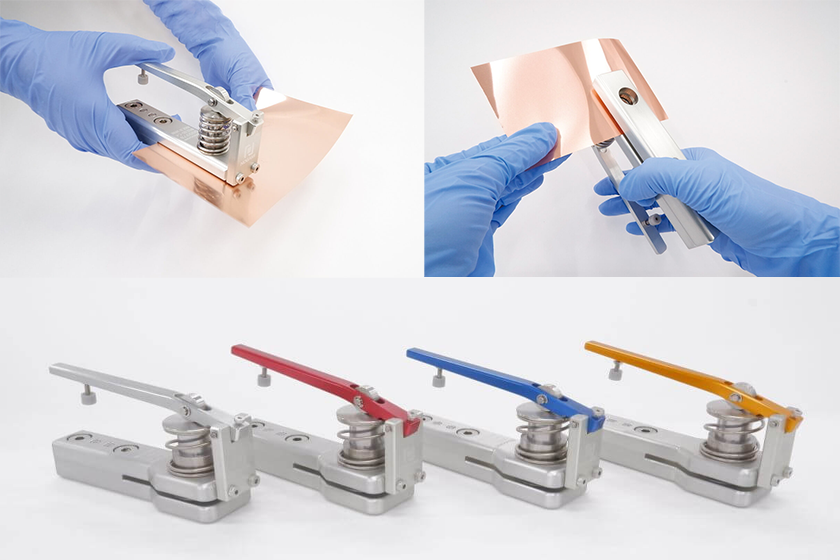
Die-cutting defects (burrs and cracks) occurring in the electrode evaluation of LIBs and solid-state batteries directly impact the reliability of evaluation data and development schedules. We propose high-performance hand punches manufactured by Nogami Giken, combined with test equipment lending and paid testing. This simultaneously improves evaluation accuracy and development speed while lowering implementation risks. Burrs and Cracks Frequently Occurring in LIB / Solid-State Battery Electrode Evaluation Burrs and cracks occur during electrode die-cutting (test samples) for LIBs and solid-state batteries, compromising the reliability of evaluation data. This affects development schedules.Existing hand punches have insufficient compatibility with electrode materials (thin films and brittle materials).● Scenarios where this becomes apparent: Existing product improvement and new material evaluation phases.● Main impacts: Increased variance in evaluation data, development delays due to re-evaluation, and risks in mass production investment decisions. Why Burrs and Cracks Cannot Be Resolved: Limitations of Blade Shape, Load Settings, and Material Compatibility In addition to the physical property limits of existing materials, there are constraints in the processing design (existing punch blade shapes and load settings).● Grounds for identification: Interviews with responsible personnel and comparative tests with existing hand punches. Countermeasures Attempted So Far and Their Limits Blade replacement of existing punches (limited burr reduction) and trial use of laser cutting (thermal effects occurred).Based on these limitations, we adopted the following approach as a more fundamental solution. Solution Approach: Proposing Nogami Giken Hand Punches × Test Equipment Lending × Paid Testing Developing new opportunities with overseas manufacturers: Assisting implementation decisions through the proposal of hand punches manufactured by Nogami Giken, test equipment lending, and paid testing. STEP. 01 Overseas Supplier Collaboration Evaluating and introducing hand punches manufactured by Nogami Giken STEP. 02 Test Equipment Lending (Consultation required case-by-case) Verifying die-cutting quality within the customer's company STEP. 03 Paid Testing Conducting proxy tests on the Nogami Giken (Fuji Chemi) side Fuji Chemi Trading's Supply System: Headquarters × China Base × Overseas Network × Nogami Giken This solution is established through a clear division of roles among multiple bases:・Headquarters / Domestic Sales: Customer contact window and test equipment coordination・Overseas Bases (China and Global): Demonstrations and deployment for overseas customers・Nogami Giken / Partner Manufacturers: Equipment supply and technical data provision● Supply System: Phased operation: test equipment lending → paid testing → formal implementation. Results of Implementation Achieved improvements in function and performance, stable quality, and reduced defect rates. Enabled the die-cutting of test samples optimal for evaluation.● KPI Candidates: Reduction in burr and crack occurrence rates / Improvement in repeatability of evaluation data / Increased adherence rate to development schedules.● Implementation Lead Time: Proceeding step-by-step from test equipment lending to paid testing and main equipment implementation. Anticipated Ripple Effects and Horizontal Expansion The benefits of implementing this solution extend beyond solving the primary issues. Please utilize this as material for internal and management proposals.・Expansion into next-generation battery evaluations such as all-solid-state batteries and sodium-ion batteries・Accompanying the evaluation phases of electrode material manufacturers and separator manufacturers・Comprehensive proposals to the LIB evaluation equipment market driven by EV market expansion・Horizontal expansion to overseas battery factories (China, South Korea, and Southeast Asia) Differences from Competitors: Why Fuji Chemi Trading is Chosen In contrast to competitors selling equipment standalone, Fuji Chemi lowers implementation risks with a package of "equipment lending + paid testing + overseas collaboration." Product Information & Specification Overview The main specifications of products with a proven track record can be selected from multiple grades depending on the application and required conditions. Representative specifications are as follows (please contact us for detailed specs). ItemSpecificationsCompatible MaterialsLIB electrodes (positive and negative) / Solid-state battery electrodes / SeparatorsDie-Cutting ShapesRound / RectangularFeaturesBlade shape and die-cutting load optimized for electrode materialsEvaluation SupportTest equipment lending / Paid testing supportRelated MarketsEV / All-Solid-State Batteries / Sodium-Ion BatteriesCollaborationDeployable to battery factories and R&D departments in China and worldwide Utilization Methods and Operation Examples In actual operations, the following patterns are frequently adopted:・Evaluation Phase: Requirement hearing → Sample evaluation → Specification finalization・Pre-Mass Production Preparation: Division of roles across bases, specification standardization, and local startup・Mass Production Phase: Ensuring short delivery times and stable supply through our supply system・Horizontal Expansion: Supporting expansion into other bases and projects FAQ (Frequently Asked Questions) What are the conditions for lending test equipment? Please consult with us on a project-by-project basis regarding lending periods, test details, and paid testing prices. Can you also support the evaluation of all-solid-state batteries? Yes, we have a proven track record in evaluating solid-state battery electrodes. Can you support implementation at overseas battery factories? Yes, deployment to battery factories in China, South Korea, Southeast Asia, and global research institutions is possible. Can you introduce evaluation equipment for components other than electrodes (separators, tabs, etc.)? We can propose evaluation equipment for all LIB processes under Fuji Chemi's "Battery Evaluation Lab." What kind of data can be obtained through paid testing? We can provide data such as burr/crack occurrence rates, dimensional accuracy, and repeatability. Proposals by Related Applications and Challenges ■ Accelerating LIB Separator Air Permeability Measurement | Improving Quality Control Efficiency Through Oken Type Air Permeability Testers × Collaboration with China Bases and Overseas Agents■ Small-Lot and Slitting Processing for FPC Release Film | Supplying Evaluation Samples with Short Lead Times from Stock Items

LIB/固体電池電極評価機器

上海拠点

品質向上 x 歩留まり改善

小ロット・スリット加工

野上技研製高性能ハンドパンチ

高機能材料 x 新規開発

Root-Zone Water Retention for Drought and High-Temperature Stress Countermeasures | On-Site Demonstration Solutions for Biodegradable Superabsorbent Polymers (EF Polymer)

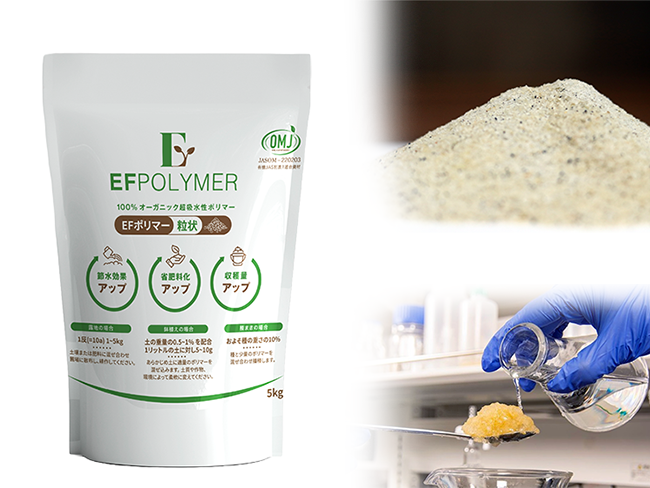
For regions where seedlings must be raised with limited irrigation, such as during prolonged dry seasons or in sandy soils, we propose a combination of the biodegradable superabsorbent polymer "EF Polymer" and a root-zone water retention process based on local verification. Starting with demonstrations in Nigeria, we are driving global expansion into the agriculture, afforestation, and greening sectors. The Water Shortage Challenge of "Prolonged Dry Seasons × Sandy Soil" Occurring in Nigeria As dry seasons lengthen and rainfall becomes unpredictable, limited irrigation is absorbed by sandy soil before reaching the root zone, making survival rates and growth unstable. Securing and efficiently utilizing agricultural water has become urgent. Even if the irrigation volume is increased, water escapes in sandy soil, leading only to soaring costs.● Scenarios where this becomes apparent: Overseas farmland and afforestation sites. Backed by the prolongation of dry seasons due to climate change.● Main impacts: Decrease in seedling survival rates, uneven growth, and deterioration of crop yields and afforestation success rates. Why Increasing Irrigation Does Not Solve the Problem: Dual Factors of Natural Elements and Soil Physical Properties In addition to natural factors (prolonged dry seasons and unpredictable rainfall), the water retention capability of sandy soil is low, making it impossible to retain water in the root zone.● Grounds for identification: Observations at local fields and control test data. Countermeasures Attempted So Far and Their Limits Increasing irrigation volume (limited by water costs and labor) and water-retaining mulch materials (washed away by wind and rain).Based on these limitations, we adopted the following approach as a more fundamental solution. Solution Approach: EF Polymer × Local Control Tests × Packaging of the Application Process Proposing a new material (biodegradable superabsorbent polymer) combined with collaboration between overseas bases and partner trading companies, and designing a root-zone water retention process based on local verification (control tests). STEP. 01 New Material Proposal Selecting EF Polymer (biodegradable superabsorbent polymer) STEP. 02 Local Control Tests Optimizing application and irrigation processes for each crop and soil condition STEP. 03 Leveraging Partner Networks Supplying locally through overseas bases and overseas partner trading companies Fuji Chemi Trading's Supply System: Headquarters × Overseas Bases / Overseas Partner Trading Companies × Partner Manufacturers This solution is established through a clear division of roles among multiple bases:・Headquarters / Sales: Project promotion and inquiry contact window・Overseas Bases / Overseas Partner Trading Companies: Local sales and distribution・Partner Manufacturers: EF Polymer supply and physical property data provision● Supply System: Verification in local fields → Packaging and supplying the application process. Results of Implementation Soil water retention capability is improved, stabilizing seedling survival and crop growth even with limited irrigation.● KPI Candidates: Improvement in survival rate / Growth volume per unit of irrigation / Crop yield / Afforestation success rate.● Implementation Lead Time: Phased operation from local verification to establishing the application process and formal implementation. Anticipated Ripple Effects and Horizontal Expansion The benefits of implementing this solution extend beyond solving the primary issues. Please utilize this as material for internal and management proposals.・Opportunities to participate in ODA and international organization (FAO, JICA, etc.) projects・Expansion into sectors other than agriculture (greening, turf, urban heat island countermeasures)・Since EF Polymer is biodegradable, it serves as a strong appeal for "plastic-free" and "prevention of soil contamination"・Brand enhancement through connection with climate change adaptation and SDGs (Goals 2, 6, 13, and 15) Differences from Competitors: Why Fuji Chemi Trading is Chosen Trading companies exporting polymers standalone have thin on-site verification know-how. Fuji Chemi can provide a one-stop service of "material supply + local control tests + application process design." Product Information & Specification Overview The main specifications of products with a proven track record can be selected from multiple grades depending on the application and required conditions. Representative specifications are as follows (please contact us for detailed specs). ItemContentProduct NameEF Polymer (100% bio-based superabsorbent polymer / water-retaining material)Raw Materials / FeaturesUpcycling crop residues such as fruit peels and pomace (circular economy)ShapeGranular / Powder / Biodegradable small pouches, etc. (depending on application and grade)Main ApplicationsAgriculture (open fields and greenhouses) / Seedlings and transplanting / Afforestation and greening (water retention and drought stress countermeasures)Potential ApplicationsBeauty and cosmetics (liquid foundation, lipstick, etc.) / Facial sheets / Packaging (earth-returnable wrapping)Related AreasOpportunities to participate in ODA and international organization (FAO, JICA, etc.) projects Utilization Methods and Operation Examples In actual operations, the following patterns are frequently adopted:・Evaluation Phase: Requirement hearing → Sample evaluation → Specification finalization・Pre-Mass Production Preparation: Division of roles across bases, specification standardization, and local startup・Mass Production Phase: Ensuring short delivery times and stable supply through our supply system・Horizontal Expansion: Supporting expansion into other bases and projects FAQ (Frequently Asked Questions) How do you proceed with local verification? We conduct hearings regarding soil quality, root structure, and irrigation methods, and then perform control tests with and without EF Polymer on a ridge-by-ridge basis. Are there any restrictions on target crops? It can be widely applied from open field and greenhouse vegetables to afforestation and greening. We design the application position and timing for each crop. Is expansion into fields other than agriculture possible? Yes, there is potential for application in greening, turf, urban heat island countermeasures, beauty and cosmetics, and packaging fields. Is collaboration with ODA and the public sector possible? Yes, we can accept consultations regarding opportunities to participate in projects for international organizations such as FAO and JICA. Can you provide multilingual data sheets? We are currently preparing multilingual reference materials for overseas projects. Please let us know your requirements. Proposals by Related Applications and Challenges CASE 20 | 100% Eco-Friendly Water-Absorbing & Deodorizing Bag (F+BAG ACE)CASE 22 | Compact Seawater Desalination Equipment WAQUACASE 01 | Reducing Factory Running Costs via Heat-Shielding Paint

EFポリマー(生分解性超吸水性ポリマー)

コストダウン

海外提携

環境・省エネ対応

高機能材料 x 新規開発

Electrical &
Electronic Materials

Inquiry form

If you have any comments, questions, or inquiries regarding our products and services, please use the form below.

This site is registered on wpml.org as a development site. Switch to a production site key to remove this banner.